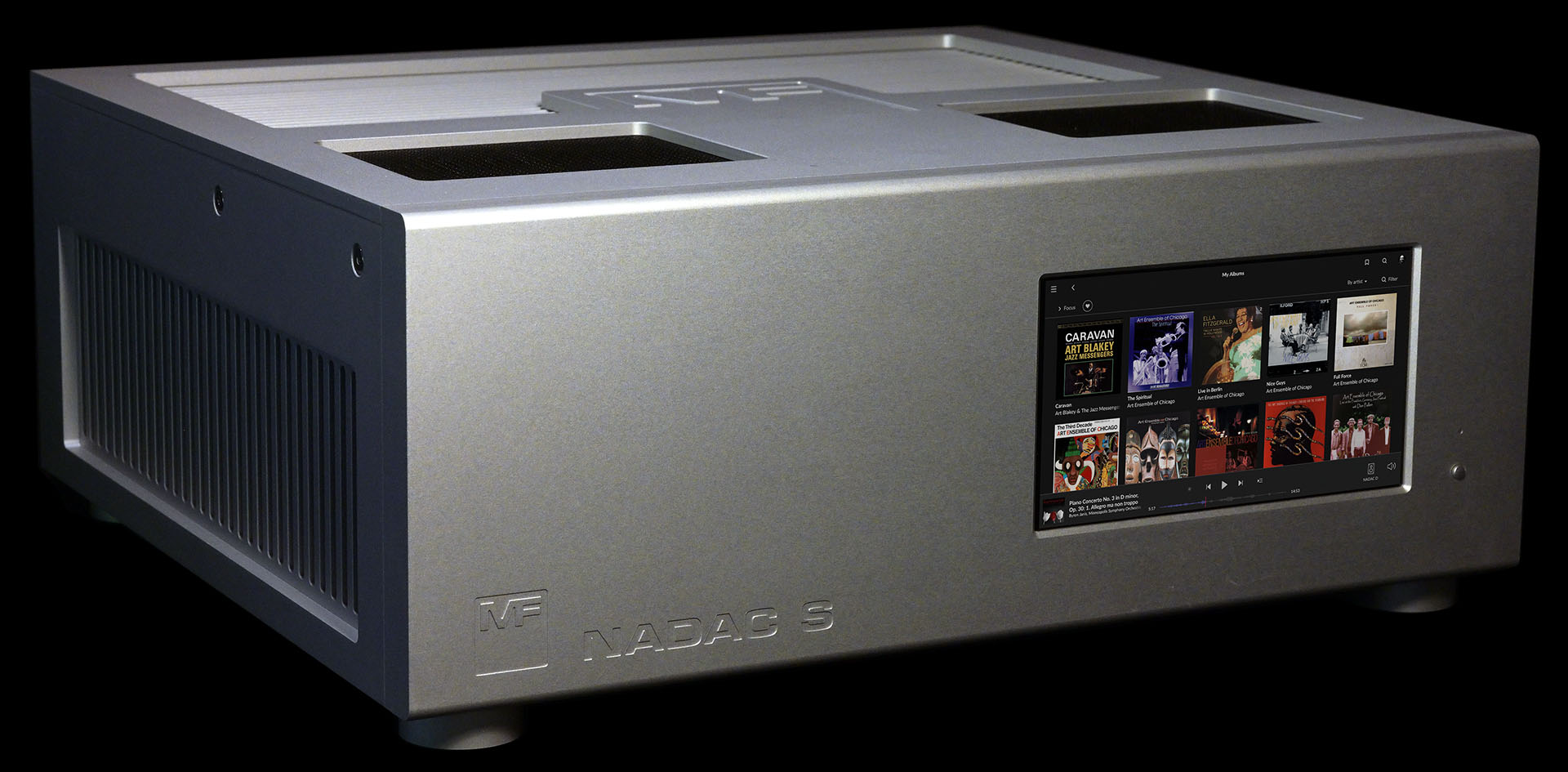

Time is of the essence. The NADAC S Music Server finally and masterfully enables the Digital Source of an integrated Audiophile Solution to operate in the same Time Domain as all other components
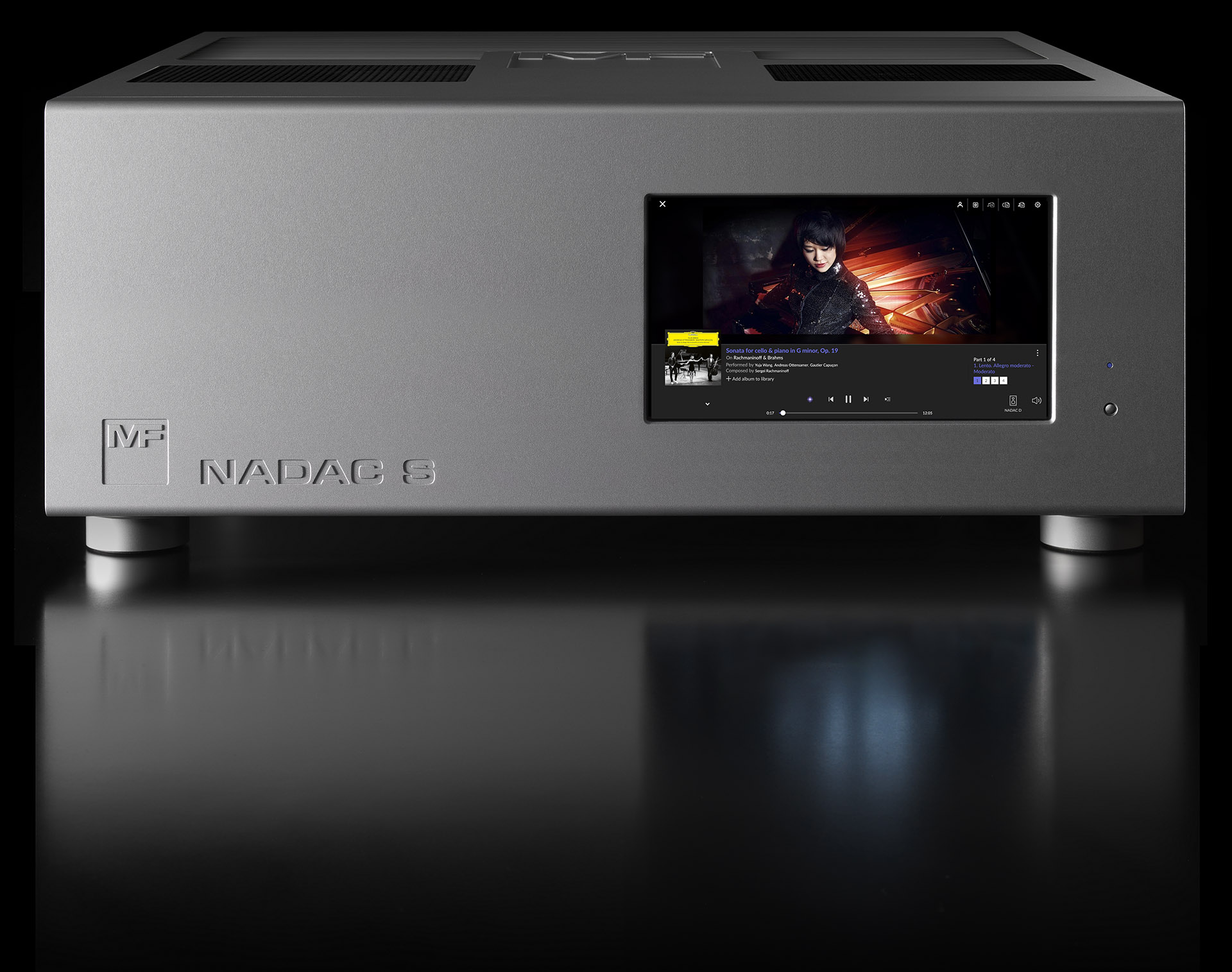
NADAC S Technology Overview
NADAC S is a truly exceptional Music Server developed by Master Fidelity specifically for working in conjunction with its world acclaimed DAC, NADAC D, and its industry reference Master Clock, NADAC C.
The True 1bit technology at the core of NADAC D operates in an extremely tightly controlled time environment, conducted by the NADAC C Master Clock. During all the research required for developing such technology, it has been clearly identified that a Digital Source designed with the same level of attention to timing purity as NADAC D and C is necessary for reaching both their standard of sound quality in an integrated solution.
This led to the decision to develop a Music Server, NADAC S, to ensure that the entire digital chain, from Digital Source to Analog DAC Output, including Connectivity, operates under the same level of time control, creating a coherent Time Domain Ecosystem preserving the lowest jitter and wander along the whole signal chain.
The implementation of this paradigm – One System, One Time Domain – in the NADAC ecosystem clearly elevates the Sound Quality of an integrated solution to new heights. Initial listening sessions immediately revealed that the Music Server component, the first element in the chain, the one which from inert digital data incarnates Music in Time, was missing this Time Domain integration. This is now finally solved !
Master Fidelity not only masters the necessary technology to design custom chips like the True 1bit at the heart of NADAC D, and the Digitally controlled Analog one of NADAC L, but also the expertise required for producing the NADAC C crystal oscillators, and today the exceptional engineering talents to finally and masterfully come up with the unique motherboard at the heart of NADAC S.
Ultra-Low Jitter External Synchronization
For digital audio systems, time-base consistency is crucial. Based on this design principle, NADAC S is equipped with an Ultra-Low Jitter 10MHz Clock Generator, that can be synchronized by an External Clock, enabling it to work synchronously with NADAC D and third-party devices supporting 10MHz external clock inputs within the unified Time Domain of NADAC C.
NADAC S does not operate in an independent asynchronous silo but rather becomes a synchronous component working collaboratively under a unified ultra-low low jitter Time Domain.
This architecture allows reverting to a synchronous USB connection between the Server and the DAC with very small and synchronous packets, avoiding any additional jitter during the transmission between the Server and DAC.
This required Master Fidelity engineers to design a proprietary motherboard enjoying a 10MHz clock input driving all components of this unique piece of electronic jewelry. From the industrial grade enterprise server Q670 chipset, the ultra-precision scientific spec dual-channel RAM, the height on-board USB-A ports, the audio optimized USB-C port, both the High-End Grade custom RJ-45 and SFP ethernet cards, all these components are driven by a custom designed 10MHz Clock module, that is ideally synchronized by a NADAC C – but can also operate with its internal OCXO crystal – drastically reducing the jitter and wander between any of these components, and between the motherboard itself and the NADAC D.
The NADAC S motherboard is unequivocally unique in the industry today and positions Master Fidelity once again at the pinnacle of digital technology design.
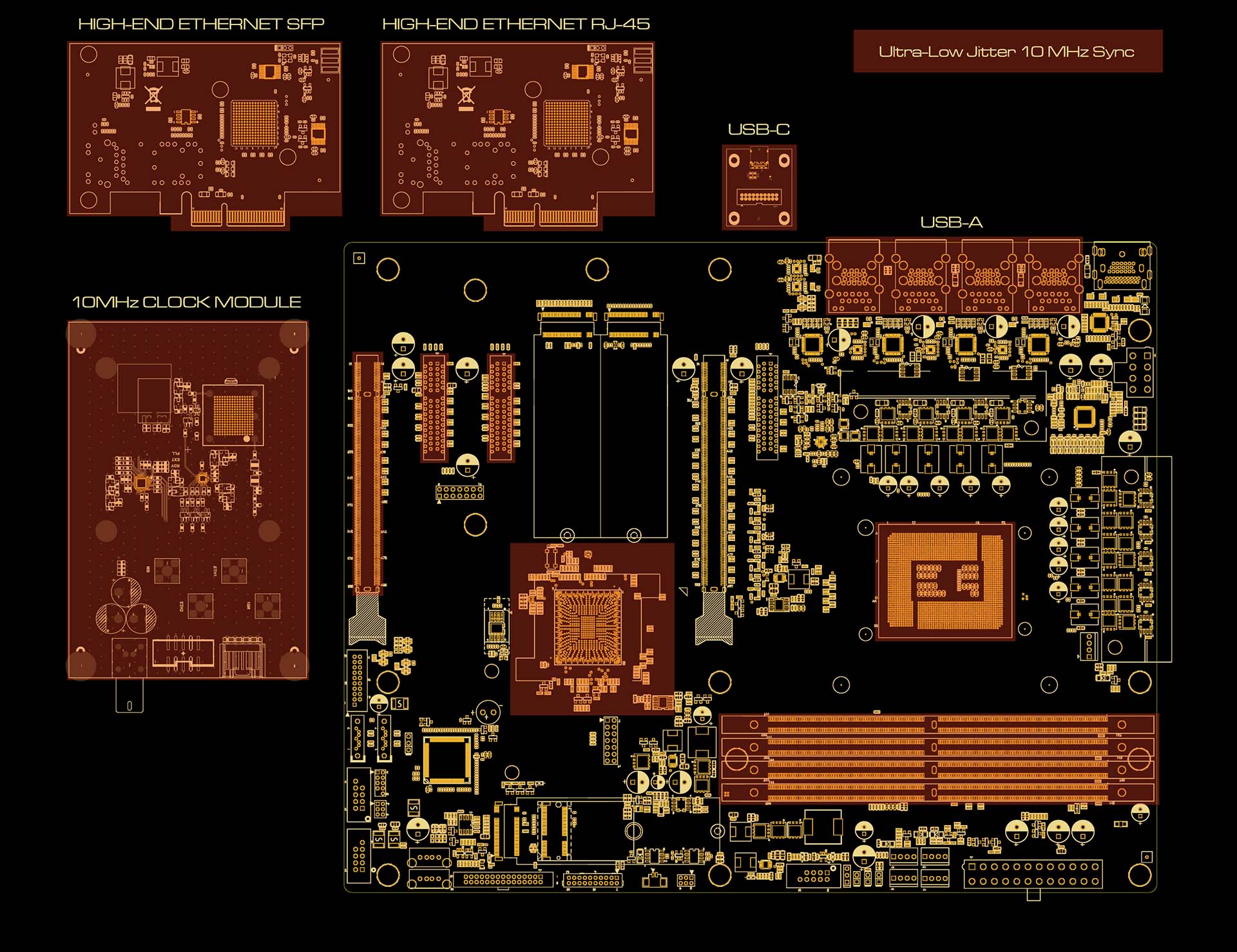
NADAC S motherboard and custom peripheral cards modules synchronized by external (or internal) 10Mhz Ultra-Low Jitter Clock
Ultra-Low Noise Linear Power Management
In addition to the critical Timing Management of the NADAC S motherboard, Master Fidelity has performed various optimizations on its architecture, especially on the no-less important aspect, Power Management.
The nine USB ports have different carefully tailored power supply sources depending on their defined use case.
The USB-C port, two of the USB-A ports and the two High-End Grade network cards enjoy an Ultra-Low Noise Linear Power supply.
Four USB-A ports are fed by Ultra-Low-Noise switching power supply.
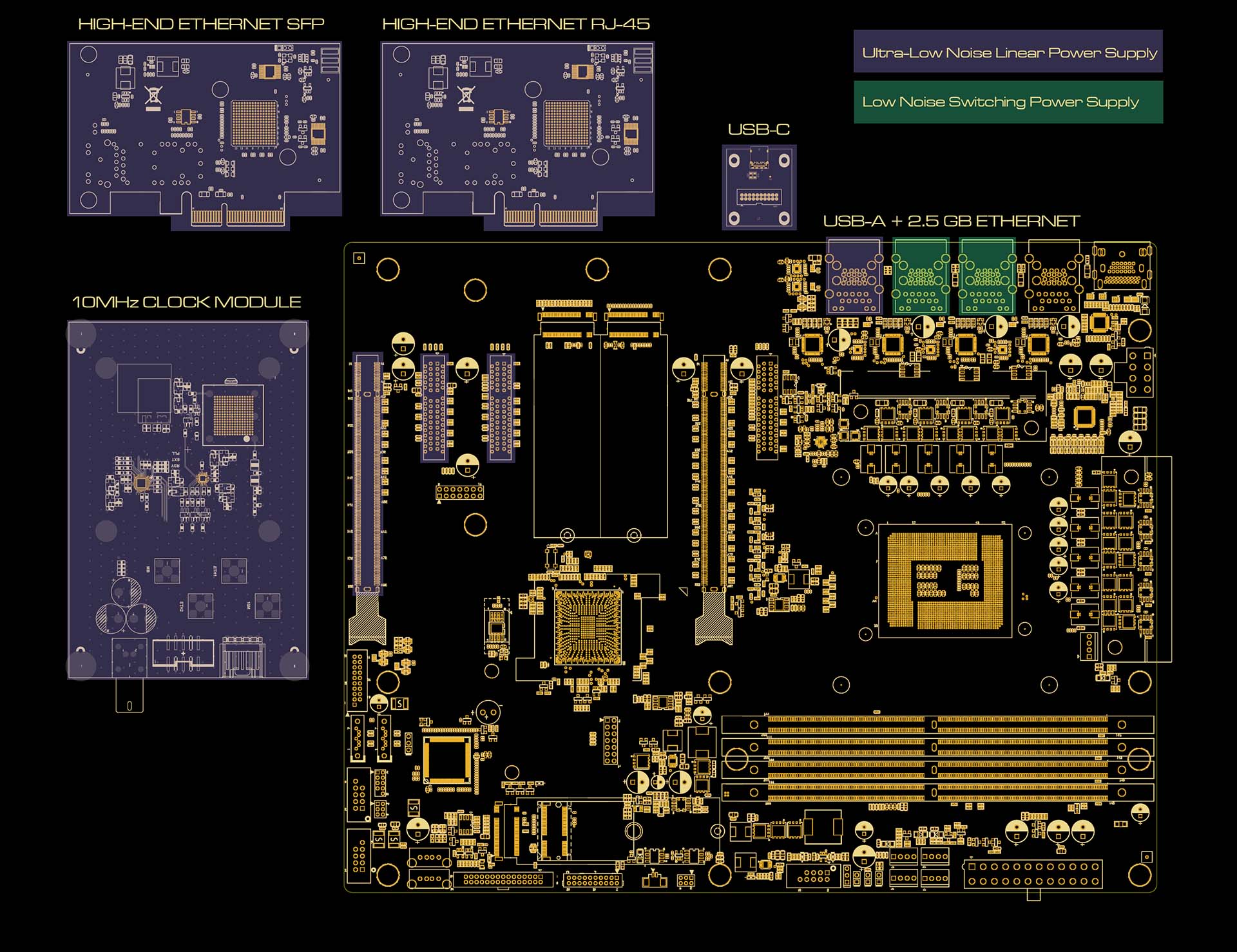
NADAC S motherboard and custom peripheral cards modules powered by Ultra-Low Noise Linear Power Supply or Low Noise Switching Power Supply
Extended and Optimized Connectivity
Benefiting from the ultra-low jitter synchronization and ultra-low noise power supply described above, NADAC S offers a large set of highly optimized communication ports.
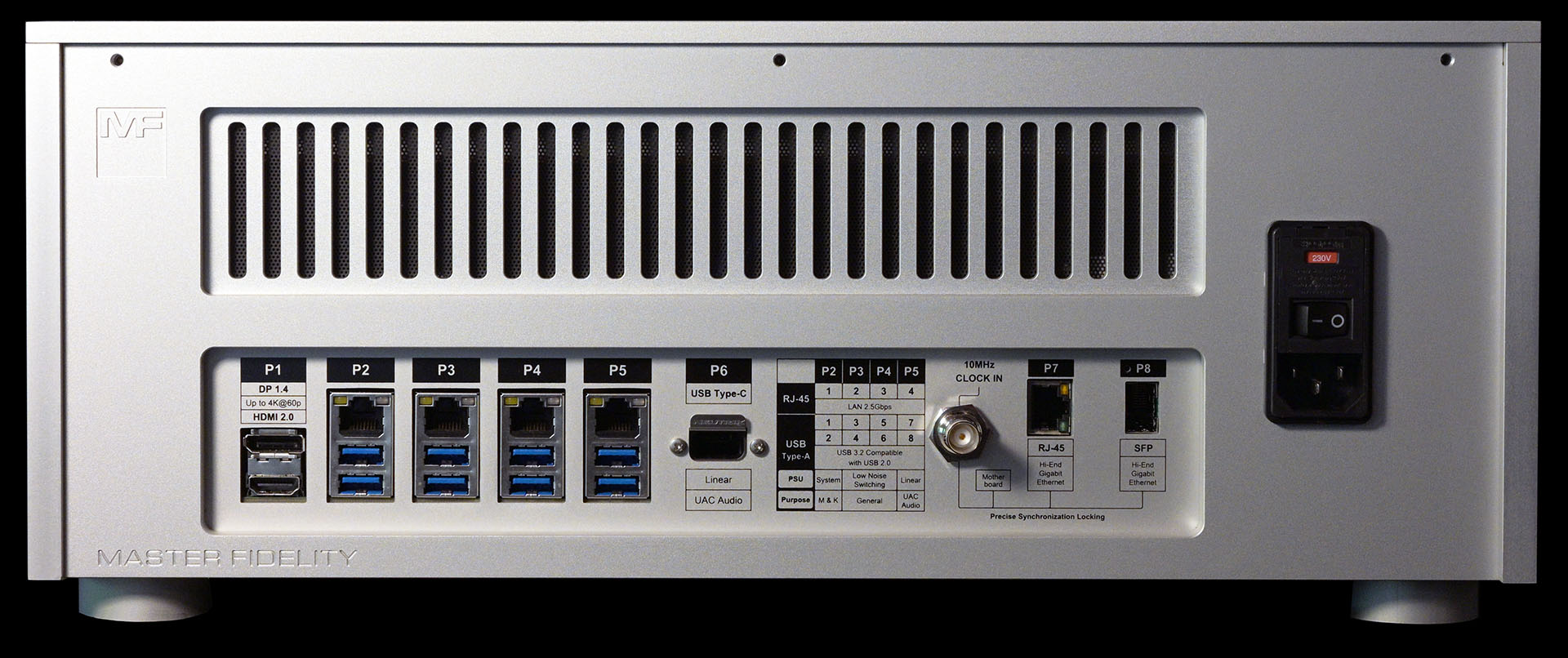
USB Ports
NADAC S enjoys nine USB 3.2 ports compatible with 2.0:
- One High-End Grade USB-C port, synched by the ultra-low jitter 10Mhz clock and powered by the ultra-low noise linear power supply, secured with a Neutrik locking mechanism. This is the recommended port to connect NADAC S to the MF NADAC D DAC using the MF USB-C to USB-C cable.
- Two USB-A ports, synched by the ultra-low jitter 10Mhz clock and powered by the ultra-low noise linear power supply. These are the recommended ports for connecting to other brands DACs or streaming audio from USB disks or memory sticks.
- Four USB-A ports, synched by the ultra-low jitter 10Mhz clock but powered by a low noise switching power supply. These are targeted to general purpose usage.
- Two USB-A ports synched by the ultra-low jitter 10Mhz clock but powered by a regular switching power supply. These are targeted to keyboard and mouse. They can be disabled if operating the unit through network connections.
Network Ports
To take full advantage of the NADAC S’s 10MHz external clock synchronization capability, Master Fidelity has independently developed a pair of High-End PCIe Gigabit Ethernet controllers called MF-PSL (Precise Synchronization Locking), which are unique and exclusive to the NADAC S:
- One High-End Grade Network port with RJ-45 connector, synched by the ultra-low jitter 10Mhz clock and powered by the ultra-low noise linear power supply. This is the recommended port for connecting to the internet to streaming services such as Qobuz, or streaming from a server or a NAS.
- One High-End Grade Network port with a SFP slot, populated as standard with an optical fiber adapter, synched by the ultra-low jitter 10Mhz clock and powered by the ultra-low noise linear power supply. This is the recommended port for streaming audio from a Server or a NAS.
In addition, NADAC S offers four 2.5Gb Ethernet ports, for general purpose use.
External Clock Port
Last but not least, reverence to the King, the BNC Clock Input Connector, to get the reference 10MHz Clock Input signal from the NADAC C Master Clock.
The Heart of the NADAC S Uniqueness hides behind this port !
Display and Control
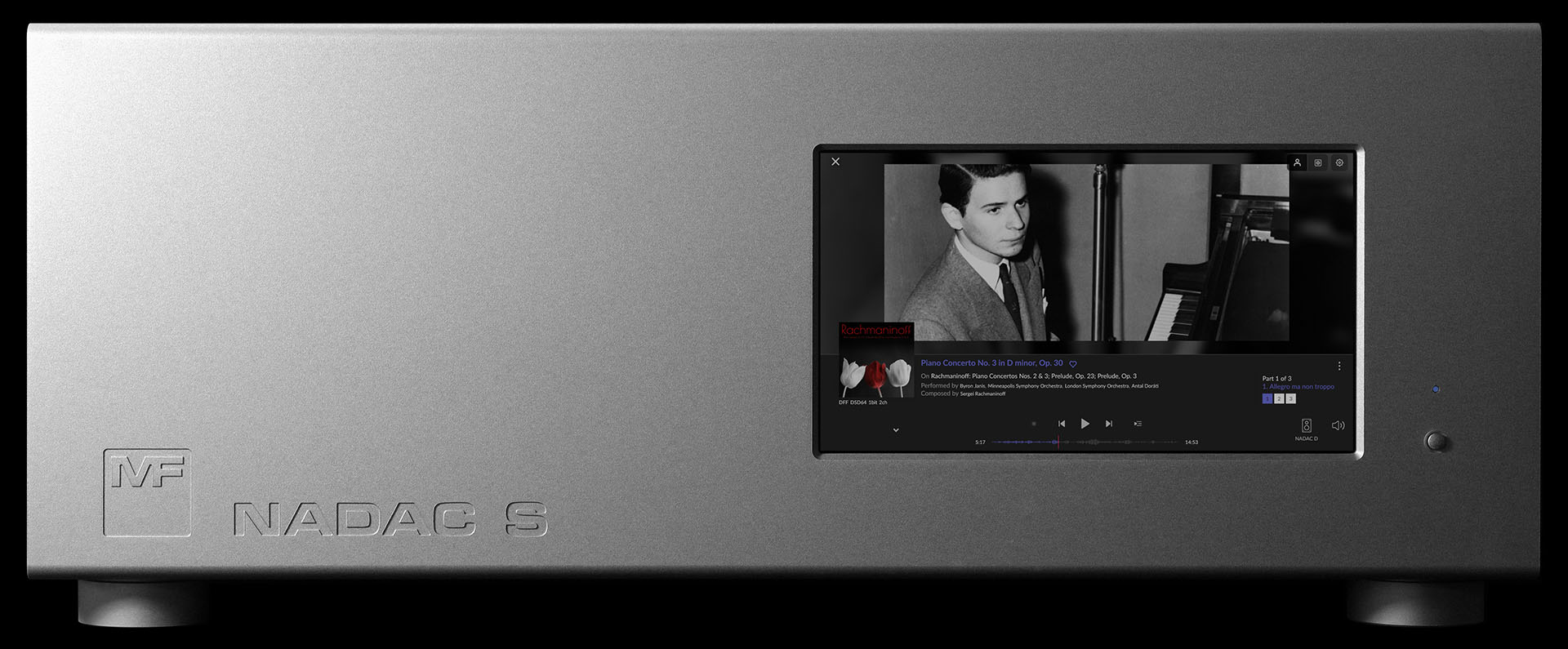
For convenient operation, the NADAC S features a 7-inch color display on the front panel with a resolution of 1920 × 1080. The rear panel offers DP 1.4 and HDMI 2.0 display output interfaces, allowing connection to external monitors and supporting up to 4K 60P output.
NADAC S is better operated from a Tablet and proper remote-control access is provided as default, using the internal display for Now Playing information.
However for easy configuration using the internal display, NADAC S is delivered with a wireless keyboard and mouse.
Storage System
As the system disk for the operating system and applications, NADAC S uses U.2 SSDs designed for enterprise servers, data center storage arrays, and high-performance workstations. U.2 SSDs offer power-loss data retention, supporting 24/7 uninterrupted stable operation, and hugely outperform ordinary consumer-grade SSDs in write endurance and long-term high-load stability, with endurance generally several to tens of times greater. Simultaneously, the U.2 SSD connects to the CPU via a high-speed interface path, providing excellent random read and write performance, further enhancing overall system responsiveness and audio experience. To ensure long-term stable operation, the NADAC S also features a large-size finned heatsink for this U.2 system disk, providing ample heat dissipation area.
For music file storage, NADAC S uses four enterprise-grade SATA SSD. For media files, the storage medium must first and foremost provide high data security. Enterprise-grade SATA SSDs can support 24/7 high-load continuous operation, possessing high concurrency capabilities and excellent steady-state performance. Their write endurance is typically several to tens of times higher than that of ordinary consumer-grade SSDs. This data drive connects to the system platform via a separate high-speed interface path, providing a shorter data transfer path and further reducing the impact of interference and signal attenuation.
Heat Dissipation and Quiet Operation
NADAC S is of course a fan-less designed system, from CPU cooling to Power Supply management, not a single moving part is involved in its operation.
A carefully self-cooling designed heatsink ensures CPU temperature control, all data center grade SSD ensure low temperature management, without forced cooling, and all system storage uses solid-state drives (SSDs).
Operating System and Applications
NADAC S is software agnostic; one can install and run the operating system and audio application of its choice.
However, Master Fidelity recommends and installs as default a Windows 11 Enterprise LTSC (Long-Term Servicing Channel), a specialized, stripped-down edition of Windows designed strictly for mission-critical and enterprise hardware — such as ATMs, medical equipment, industrial controllers, kiosks, airport services, etc — where long-term stability and minimal updates is required.
Master Fidelity further optimized this industrial OS build by removing specific services subject to generate undesired noise, traffic or CPU usage.
But NADAC S can also be installed with any distribution of Linux, being general purpose ones like Ubuntu, or audio optimized ones such as AudioLinux or AP-Linux.
In term of Music Server application, Master Fidelity validates and performs stress tests on most of the industry standard applications, such as Roon, HQ Player, Audirvana, JPlay, etc… to name a few.
In addition to the Operating System and Music Server applications, the motherboard and CPU, carefully selected and customized by Master Fidelity, allows for easily running various additional algorithms, like convolutions, up-samplers, room corrections or any specific software requiring intense horse power.
Combined with its unique Synchronization Model, carefully crafted Power Management and exceptional Connectivity, NADAC S Computing Platform is an Audiophile and System Integrator Dream !